Resources / Health & Conditions
Why a Predictable Day Makes Dementia Care Easier (and How to Build One)
· Oakcare Team
The hard afternoons with a parent who has dementia are rarely random. A predictable daily routine reduces distress. Here is how to build one at home.

Some days with a parent who has dementia go okay, and some days fall apart, and at first it can feel random. Usually it isn't. When you look back at the hard afternoons, the same things are often underneath: a skipped meal, a bad night's sleep, a day with no shape to it, too much noise, too many decisions asked of someone who can't make them easily anymore.
A predictable day cuts down the number of moments that tip into distress, for your parent and for you. Here's how to build one without turning your home into a hospital.
Why routine does so much of the work
Dementia makes it hard for a person to keep track of the day, what just happened, what comes next, what time it is. That uncertainty is frightening, and the fear comes out as agitation, resistance, or asking the same questions over and over. A steady routine gives some of that structure back. When meals, rest, and activity happen at roughly the same times in the same order, your parent's body and habits carry them through the day even when their memory can't.
The Agency for Integrated Care points families toward consistency and a calm environment for the same reason: fewer surprises, because surprises are where the distress usually starts.
Anchor the day to a few fixed points
You don't need to plan every hour. You need a few reliable anchors the day hangs on: waking up and a proper breakfast, lunch, an afternoon rest, dinner, a wind-down, and bed at a consistent time. Keep these the same even on weekends. The sameness is the point.
Between the anchors, you have room to be flexible. But protect the anchors. A lunch that drifts two hours late means a blood-sugar dip and a tired, hungry parent going straight into the most fragile part of the afternoon.
Put the demanding things in the morning
Most people with dementia cope better earlier in the day. Energy and clarity fade as the afternoon goes on, and for many, the late afternoon brings restlessness or agitation, sometimes called sundowning. So put the harder tasks, bathing, appointments, anything that takes effort, in the morning when your parent has the most to give. Keep the afternoon and evening for calm, familiar, easy things.
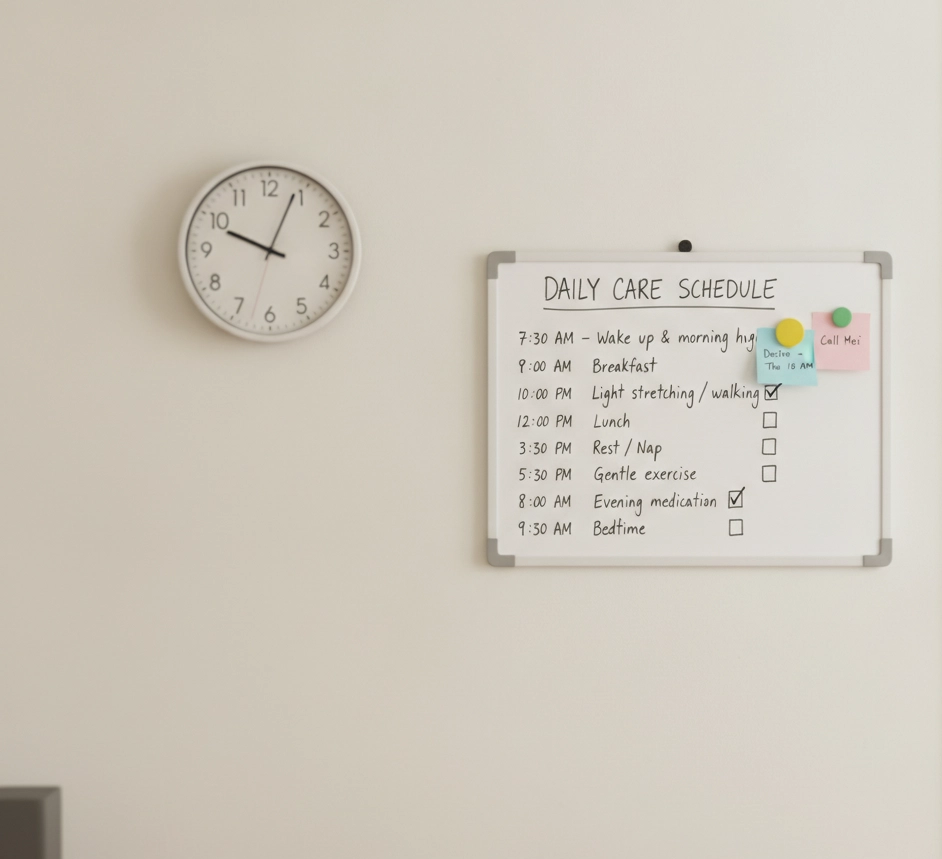
Make the day visible
A big clock and a simple written plan for the day, put somewhere your parent naturally looks, takes pressure off everyone. "Breakfast. Walk. Lunch. Rest. Dinner." Five words. It gives your parent something to check instead of asking, and a small sense of knowing what's going on, which settles them.
Keep the surroundings calm to match. A TV blaring while you're trying to talk, three people speaking at once, clutter everywhere, these small things pile up. Turning down the noise and clearing what's in view often settles a restless parent more than anything you say.
Build in movement and something to do
A day with nothing to do isn't restful for someone with dementia; it's empty, and empty time fills up with anxiety and wandering. A short walk, even just around the void deck, helps sleep, mood, and appetite. Simple, familiar tasks that feel useful, folding laundry, sorting things, helping prepare a meal, matter more than whether they're done "correctly." The point is feeling useful, not the result.
If you're at work during the day, dementia day care centres give structure, activity, and company in a place set up for it. They're listed through the AIC's care services for dementia, and many families find it steadies the whole week, not just the hours their parent is there.
Protect sleep, because it protects the day
Good days start the night before. A dark, quiet room, a consistent bedtime, less napping late in the afternoon, and cutting caffeine after lunch all help. Poor sleep makes confusion and agitation worse, which wrecks the next day, which wrecks the next night. Breaking that cycle is some of the most useful work you can do.
When a steady routine needs more than one person
A calm, consistent day does a lot of good, and most of the work of keeping it up, meals on time, the morning bath, the afternoon walk, falls on whoever is there every day. When that's one person who also has a job, the routine tends to slip, not because it doesn't work but because no one can keep it up alone.
A live-in carer with dementia experience can hold the rhythm even when you can't be there. That's the difference between a routine that exists on paper and one your parent actually lives by.
You're not trying to run a perfect day. You're trying to make more of the days feel steady. That's enough.
If keeping that rhythm has become too much for one person, tell us about your parent and we'll talk through what support at home could look like.